Pages

Wednesday, March 13, 2019

Folaha Water

Folaha Village has solar water system, which does not provide enough water for the peak times of the day. Water is not available between 6-9 in the morning or 5-8 in the evening, the prime times for cooking and getting ready for the day or clean up after working in the fields. The water committee chair requested LDS Charities to provide a submersible electric pump. The village paid for the electric power to be brought to the water pump house, across the street from the solar panels. The village also paid for the solar power system.

Our contractor TEMA Tonga installed the submersible pump and hooked up the electric power to the controller. Folaha now has water 24 hours per day. They can cook and bathe without worry of running out of water.

We are so happy to have been able to help Folaha to obtain 24-hour water supply.
Makisi shows Elder Thomson the controller
Celebrating the flow of water from the new pump


Good clean water is essential to life. We in North America do not understand having to boil water every day for drinking and cooking. For many in Tonga, this is the norm. Another norm is cold showers. Most in Tonga do not have hot water, in fact shower houses are almost always outside as well as outhouses.


I woke up. I have clothes to wear. I have running water. I have food to eat. Life is good. I am thankful.           

Sunday, March 10, 2019

Lost at Sea - Meke Tukuafu

Paea (Meke) Tukuafu 1977
Our friend Meke came to family home evening with the senior missionary couples to tell his remarkable story of being lost at sea for 16 days! Details were also taken from the book Taratai II written by James Siers, captain of the ship. This adventure took place on a journey from Tonga to Rarotonga, 700 miles east. Meke (whose real name is Paea) was age 20. He was a professional fisherman on a Tongan long-line ship and had been sailing for 2 years; he was a confident sailor.


Aug 8, 1977, 6 weeks into the voyage, Taratai II was hit by a very big wave. The float fell into the trough. As it was righting, another big wave caught it. The canoe flipped on its side, the outrigger float broken off, the mast smashed, and the big waves kept coming.

Paea went below to find Conrad, 10-year-old boy. If he had not been able to get Conrad, the boy would have perished. The life raft had broken free of the boat when the beams had broken underneath. Within seconds it would be out of reach. Paea and Rob dove into the sea, swam to the life raft and drug it back to the canoe. The rescue beacon was found and placed in the life raft. The radio responded at first, then went dead. They made the life raft ready…pulled the inflation cord, loaded 36 liters of water, biscuits, a dozen cans of corned beef, 18 cans of mackerel, and essential navigation gear. They agreed they should sleep in the raft and decide in the morning what to do. In the morning, the crew decided to abandon Taratai II and go on with the life raft. They felt they would drift more quickly back to Niue, about 200 miles, on the life raft than they would on the stricken hull. They thought they would reach Niue in a couple days.

There were 7 in a rubber life raft. Waves roared and crashed around them. Strong wind whipped, seas roared in the black night; the sea was confused. Squalls tore at the canopy. Huge waves towered above them.

Food and water were rationed, 115 mL water per day, 2 cabin biscuits per person, 1 can of corned beef or mackerel and 1 milk biscuit each. There was barely room for the 6 men and one boy. They slept with legs bent, no room to stretch. There was always water on the floor. They sat in water to their waist. Skin split on lower back and buttocks…salt water burns. 

Each morning started with prayer and a devotional and the evening closed with the same. “The lotu, or prayer, has become one of the most cherished parts of the day as it fills us with hope and faith. It makes us feel that we will be blessed with appropriate winds to speed our deliverance.”

Aug 15 about 8 pm, we realized water was rushing in. “A hole!” yelled Paea. He stemmed the flow with his hand. They knew the hole had ripped without cause. “We are on borrowed time.” They used bandages from the first-aid kit to plug the hole. They found a new hole, then another. They kept plugging them with bandages.  “We can last a long time if we have a floor. Without it, we are at the mercy of the big fish below. If they don’t get us, exposure to the cold will.”

Aug 16 , we revised provisions: one cabin bread biscuit, one large spoon of mackerel, 115 mL of water daily. Water plugs held but there was seepage. 

Aug 19, an airplane was heard. They got the beacon out. The plane was flying low. There were thick clouds. The plane did not see them and did not respond to the beacon signal.

Aug 20, the floor opened again. Water rushed into the raft. 3 new holes. They bailed continuously. Another plane flew overhead. It also did not pick up the beacon.

Aug 21, water missing in morning – 4L. They appointed 2 men to be keepers of the water. Water is most precious. "By taking a little, we can survive a long time. When it is gone, we are dead."

Aug 22, men were losing hope. Fia told them that if they were not rescued, he would be dead in 2 days. Others felt they would not be strong enough to fight through surf or drag themselves over coral reefs. Sharks and barracudas abound. One morning, they looked out the canopy to see a large shark! It continued to follow the raft. As they were settling to sleep at 8 pm, it happened. “Listen, I can hear a ship’s engine.”

They sent up a parachute flare which seemed to light the whole sky. A ship passed about 2 miles away, and now was about 4 miles away. Had they seen the flare? It seemed to turn and head toward them. The ship blew its horn. The ship was coming! The boat pulled aside, they grabbed the rope. One by one the men painfully scrambled onto the ship. All survived.

Paea (Meke) Tukuafu, 2019
The boat was Chilean. Liter upon liter of fruit juice was given the survivors. Fia called for prayer. "We must thank God for our deliverance." By 10 pm, they were at Alofi, Niue. Hearing by radio of the rescue, a huge crowd awaited them. Ambulance took them to the hospital. Upon clearance, crew members were taken into local homes.  Since the crew had lost all their clothes and only had what they wore, the Niue people took up a collection and provided clothing. One old man walked 16 km to bring a shirt. They too were fishermen and knew the anger of the sea. They were happy to help these who had survived so long at sea.                   
      Believe in Miracles ,  Hope is never Lost.
                            Jeffrey R Holland

Saturday, March 9, 2019

Tuiasoa Feeding Lunch to Ha'alalo GPS Students

Bishop Latu Timote Tuiasoa of Ha'alalo Tongatapu has for a long time thought about the
Government  Primary School of Ha.alalo where he went to school as a child and he now lives across the street from the school.

At lunch time, many children go home to no parents at home - father working in the plantation, mothers doing  tapa cloth and weaving mats to earn money for the family.

Bishop Tuiasoa is from a family of 12 children, 5 boys and 7 girls; he is the second to the oldest. All his brothers and sisters live in the US except the Bishop and his oldest sister. Bishop Tuiasoa and his wife have 8 children, 4 boys and 4 girls. They also have 47 grandchildren and 7 great-grandchildren.

Last year, the Tuiasoas had a Family Reunion in Tonga. Most of his brothers and sisters came as well as his children. He suggested to them the idea of feeding the primary school once a month. Some of them were willing to send donations to start the project.


Bishop called us and asked us to help. On the 21 Feb 2019 we came to help launch the project.

Lunch consisting of chicken, hot dogs, hard-boiled eggs, rice, and orange drink were served.

The Principal of the school appreciated the Bishop and his family and ward members for the helping  hands.


I have wept in the night for the shortness of sight
That to somebody’s need made me blind;
But I have never yet felt a twinge of regret
For being a little too kind.   

                  President Thomas S. Monson in General Conference Oct 2016

Nuku'alofa GPS Learning on the Floor

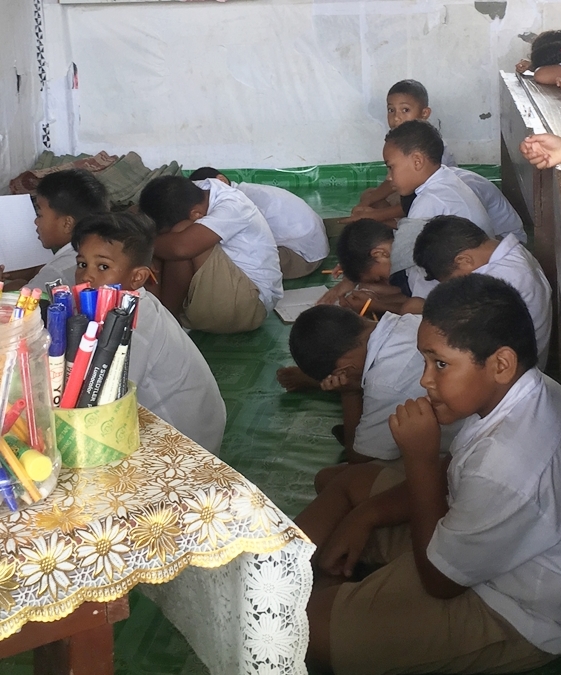
We received a request for school desks and chairs from GPS Nuku'alofa. We checked back at our records and saw we had taken 80 desks and chairs last year, so we were going to say no and move on to more needy school. Something told us to check this out.

We found enrollment has gone up significantly this year, and we also found our friendly principal who was at Maufunga GPS last year. How nice it was to see him again. There were many children sitting on the floor with NO desks and NO chairs. We earmarked this school to be helped again.


Some students had chairs that had been fixed (?).

A container arrived and we quickly organized the contents and picked out furniture for Nuku'alofa. Oh Happy Day!  When we arrived, SMILES were everywhere.

The teacher did not know we were coming, and was a bit confused and irritated with all the noise and laughter and inattention to the assignment they were supposed to be working on. Then she looked at the door and all work ceased. The oldest boys helped with unloading. We actually had enough tables for class 6 students as well whose desks were in very poor condition.


We came back a few days later for the handover. We love seeing dancing and listening to singing. These students are very appreciative of the desks and chairs.


Give your hands to serve and your hearts to love.  
                Mother Teresa

Friday, February 15, 2019

Liahona Farm

Tevita Mekihele, Farm Manager
This information was obtained in an interview with Tevita Mekihele, Liahona Farm Manager.

Liahona Farm started about 1950 as part of Liahona School. The farm consisted of chickens, pigs, dairy cattle, and beef cattle. The cattle were first kept at Mekeke (about 8 miles from Liahona) and then Niumate (about 2 miles west of Liahona). The herd consisted of about 750 animals including calves, steers, bulls, and heifers; of which about 400 were cows. Food crops were also grown at Niumate.


The main purpose of Liahona Farm was to provide food for Liahona students. The students were required to work on the farm - planting and harvesting crops, and cooking food. Classes in animal husbandry taught the boys about breeding, rearing, and caring for cattle. After graduation, thee boys graduated could use this information in their daily lives when they had their own farms. Agriculture classes continue to be taught at Liahona High School. The Farm provides learning for Liahona students as well Tonga Institute of Science and Technology (a government tertiary school).


When the cafeteria was closed at Liahona High School, the piggery and the dairy were closed at Liahona Farm. Beef cows were kept, but the program must be self-sustaining. Thus, cattle are sold to cover the expenses of the farm.
A few years back, the cattle program was reduced. The herd is now maintained at about 80 animals to include 53 cows. Liahona Farm was also moved to be a part of the Welfare Program.

The farm’s purpose now is for education and to make use of the land. The farm also fills priesthood requests and church functions. An example is when the King passed away, Liahona contributed cows to the Royal family for the feast and to sell in order to provide church gifts such as tapa and mats.
Tevita 'Asi (Farm employee) checks on this garden


Liahona Farm now places a big emphasis on teaching gardening. A “Learning Garden” was built in about 2016. Priesthood leaders and villagers visit the “Learning Garden” to become knowledgeable in new and better ways to garden. Vegetable gardening encourages better nutrition. The typical Tongan diet lacks fresh vegetables. Liahona Farm provides seedlings to people who come to the “Learning Garden” to help get them started in gardening. Tevita and his crew teach how to make keyhole gardens which is similar to raised bed gardening (see prior post). Over 1000 keyhole gardens have been started in the last few years on the island.
Separating cows in AI program from the others
Recently Liahona Farm was selected to participate in an international program to build up the cattle herds in developing countries. Artificial insemination (AI) will enable new blood lines to get into the herd.

The cows must first be separated in fields for those participating in the program and those not.

The cows are first given a pregnancy test, a few weeks later another pregnancy test. They are also given immunizations to ensure they are healthy. Finally, the cows will be artificially inseminated. 


AI is a powerful tool employed for livestock improvement. In artificial insemination the germplasm of the bulls of superior quality can be effectively utilized without regard for their location in far away places. AI is used to increase the genetic pool with which the animals can be mated, potentially decreasing effects of inbreeding. The Liahona herd is in need of the new blood so this AI program will be a benefit to Liahona Farm as well as the research team. 

The AI program provides learning opportunities for the students. High school students from around the island come to the farm to learn about artificial insemination.


All things bright and beautiful, All creatures great and small,
All things wise and wonderful, The lord God made them all.

Sunday, February 3, 2019

Red Cross Shelter Training


Tom from NZ and Rob Dobb based in Fiji
We were invited to attend the Shelter Coordination Workshop put on by the International Federation of Red Cross and Red Crescent Societies. Two men from the IFRC facilitated the workshop, Rob Dobb based in Fiji and Tom from New Zealand. They had many pictures of shelters being used in recent responses throughout the Pacific including the volcano eruption in Vanuatu with evacuation from the island and floods in Fiji.
     

Vanuatu shelters for persons evacuated from island of Ambae to island of Santo because Mt Manaro volcano eruption
We rubbed shoulders with the various participants in the shelter aspect of emergency response in Tonga. We will work with them in the event of another cyclone or other emergency here in the Kingdom. These are important contacts .. people we should have worked closely with after Cyclone Gita, but had not made these contacts before the cyclone. Now we feel we have met them and will continue to be involved with meetings so we will be able to work together with the next event.


A shelter kit contains a saw, hoe, machete, shovel, measuring tape, hammer, pliers, tie wire, rope, shears, different kinds of nails, plus of course the tarp. From these materials. the shelters are constructed.

At the workshop, participants were divided into groups and each group made a shelter, No construction was wrong, although some were "better." One group used 2 tarps and were able to construct a shelter with 2 rooms. They felt this would allow for privacy when needed.
Basic Shelter

2-room shelter


Preparing for emergencies has been a big concern for us here in Tonga. We learned some things from Cyclone Gita about being better prepared. We have been restocking our emergency container at Liahona and setting up containers in Vava'u and Ha'apai. This workshop opened our eyes to shelter needs.

Rob Dodd let us know how to purchase these tarps from Red Cross and we are in the process of getting some to have in our container at Liahona. This is at a HUGE cost savings. We have searched for good quality tarps and they are very expensive. By purchasing through Red Cross they are much more affordable. Our Pacific Area supervisor approved us to purchase them for Tonga as a trial. If we feel they are good, the purchase may be extended to the other Pacific Islands.


It wasn't raining when Noah built the Ark

'Eua Houma Water

'Eua is the only island in Tonga that has a river which runs through Mountain Vaiangina.The village of Houma receives its water from thi...